Join our webinar on Dec. 17th to learn more about “The AI Opportunity for Oncology” with Dr. Yach in conversation with Garvin Jabusch and Erika Karp.
Time: 11 AM EST / 8 AM PST
Global cancer is on a steep upward curve, but the story is not only one of rising numbers. Between 1990 and 2023, new cancer cases more than doubled to around 18–20 million annually, and deaths rose by three-quarters, even as age‑standardized mortality fell, thanks to better prevention, screening, and treatment. By 2050, forecasts suggest about 30–35- million new cases and over 18 million deaths each year, with more than half of diagnoses and up to two‑thirds of deaths in low- and middle-income countries (LMICs). Cancer cases and deaths could nearly triple in LMICs, compared with less than a 50 percent rise in high income settings, underscoring a widening equity gap.
That’s a staggering $25.2T global burden, in international dollars (at constant 2017 prices), equivalent to an annual tax of 0.55% on global gross domestic product, according to a study published in the Journal of the American Medical Association (JAMA) – Oncology, that projected the economic cost of 29 cancers in 204 countries and territories. [1]
While the outlook is harsh, the resources and ability to change course still exist. We have the capital for the pivot.
AI plus biotech: a powerful flywheel
For both health systems and investors, the most exciting signal is how AI amplifies advances in biotechnology. AI models now integrate clinical history, genetics, behavior, and imaging to flag smokers and other high‑risk groups for tailored harm‑reduction and cessation support, turning prevention into a precise, proactive service line. AI already improves early detection of lung, breast, and prostate cancers by reading scans, pathology slides, and molecular data more consistently than conventional methods, enabling earlier, less toxic interventions. When combined with next‑generation diagnostics and immunotherapies, AI-guided care strengthens the entire value chain—from discovery to real‑world outcomes.
Re‑imagining care pathways in every country
AI is also redesigning treatment and follow‑up into continuous, data‑driven processes. By fusing imaging, genomic, and lab data, AI helps clinicians stage disease accurately and match patients to the right sequence of surgery, radiation, chemotherapy, and immunotherapy—minimizing side effects while protecting cure rates. Long‑term, AI‑enabled monitoring and digital coaching can weave physical activity, nutrition, and mental health into everyday life, turning survivorship into a structured, scalable program rather than an afterthought.
Tackling stigma, prevention gaps, and legacy models
To unlock this potential, three stubborn barriers must be confronted. First, stigma around cancer—particularly lung cancer, still heavily associated with blame—remains a quiet killer, discouraging symptom reporting, screening, and trial participation. Second, prevention lags what is technically possible; tobacco control, vaccination, pollution reduction, and metabolic risk management explain a large share of avoidable cancers but remain underfunded relative to treatment. Third, cancer programs in many LMICs still mirror legacy models built around centralized tertiary hospitals and specialist shortages. AI can help these regions leapfrog to networked, virtual-first cancer systems: algorithm‑supported triage, point‑of‑care diagnostics, and tele‑oncology that extend expertise to district hospitals and community clinics without replicating the full high‑income infrastructure footprint.
Why the long‑term, inclusive view pays
Today, far too many with cancer are told that palliative and compassionate care are their only options.
We have witnessed rapid improvements in survival over the last 5 years for what have been among the most frequent and deadly cancers, namely lung, melanoma, and localized pancreatic and liver cancers. This has all deployed AI for some functions, and is likely to accelerate over the next 5-10 years, transforming most cancer management into our current approaches to common chronic diseases.
For patients and their families, this convergence means a future where early diagnosis is routine, treatment is more precise and tolerable, and survivorship is actively supported rather than left to chance.
For investors and industry leaders, it signals a multi‑decade innovation and infrastructure cycle: data platforms, AI models, companion diagnostics, digital therapeutics, and new care delivery models, all underpinned by growing cancer burden and unmet need in emerging markets.
Public-private partnerships are another important factor. The first AI-driven cancer research platform, the Cancer AI Alliance (CAIA), has secured $65M in philanthropic funding and in-kind support. Combining experts from the Dana-Farber Cancer Institute, Fred Hutch, Memorial Sloan Kettering, and Johns Hopkins, it is backed by AWS, Deloitte, Microsoft and NVIDIA to apply “responsible AI” to large, multicenter oncology datasets. [2]
Capital that takes a long‑term, globally inclusive view—backing solutions designed from day one for use in Nairobi as well as New York—stands to do well by doing good, helping turn a looming cancer wave into a catalyst for more equal, AI‑enabled progress in health.
By Derek Yach MBChB MPH, Global Head Strategies LLC
[1]Chen, Simiao, Zhong Cao, Klaus Prettner, et al., “Estimates and Projections of the Global Economic Cost of 29 Cancers in 204 Countries and Territories From 2020 to 2050”, JAMA Oncology, Feb. 23, 2023.
[2] https://www.canceralliance.ai/
By the numbers…
The estimated global economic cost of cancers from 2020 to 2050 is $25.2 trillion in international dollars (at constant 2017 prices), equivalent to an annual tax of 0.55% on global gross domestic product, per the JAMA study
The 5 cancers with the highest economic costs are tracheal, bronchus, and lung cancer (15.4%); colon and rectum cancer (10.9%); breast cancer (7.7%); liver cancer (6.5%); and leukemia (6.3%). China and the US face the largest economic costs of cancers in absolute terms, accounting for 24.1% and 20.8% of the total global burden, respectively.
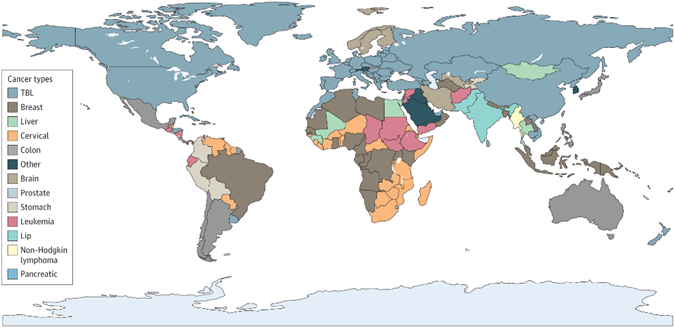
Cancer type with the largest economic cost in 2020–2050 for each country
(TBL: Tracheal, bronchus, and lung cancer)
As of the date of this publication, portfolios managed by Green Alpha Advisors, LLC held positions in NVIDIA (NVDA). Green Alpha does not hold positions of Amazon (AMZN), Microsoft (MSFT), or Deloitte (private). These securities were mentioned for illustrative purposes only and do not constitute a recommendation to buy or sell any security. Holdings are subject to change at any time without notice.
Green Alpha is a registered trademark of Green Alpha Advisors, LLC. Green Alpha Investments is a registered trade name of Green Alpha Advisors, LLC. Green Alpha also owns the trademarks to “Next Economy,” “Investing in the Next Economy,” “Investing for the Next Economy,” “Next Economy Portfolio Theory,” and “Next Economics.” Green Alpha Advisors, LLC is an investment advisor registered with the U.S. SEC Registration as an investment advisor does not imply any certain level of skill or training. Nothing in this post should be construed to be individual investment, tax, or other personalized financial advice. Please see additional important disclosures here: https://greenalphaadvisors.com/about-us/legal-disclaimers/