
Every price is a story. Some stories end.
In brief: Asset prices are often shaped by narratives, and narratives can be challenged by manufacturing cost curves. It happened to aluminum, natural pearls, and the emperor’s purple; it is happening to mined diamonds in real time, with De Beers’ parent taking significant write-downs as lab-grown stones gain share in US engagement rings. Fossil fuels may present a related structural case — an extracted incumbent facing manufactured substitutes on learning curves — and the potential opportunity may sit at the physical bottlenecks, not the photogenic layer. On July 22, we go inside the diamond collapse live with historian Aja Raden. The math may eventually win; the question for investors is how to evaluate positioning, timing, and risk discipline.
To understand markets as they are and to allocate capital with conviction, the first thing you have to do is abandon a comfortable delusion: that asset prices are driven purely by objective fundamentals.
They aren’t. Value is driven, primarily, by narrative. The market is not a spreadsheet; it is a story we tell each other about the future, with a ticker attached. For most participants, most of the time, the story is the fundamental. Sometimes the story tracks the physics; sometimes it drifts for decades, because narratives are never marked to reality on a schedule.
For a disciplined investor, this is not cause for cynicism. It is a source of potential opportunity, subject to meaningful uncertainty. Durable return potential may live in the gap between a consensus narrative that has divorced itself from physical reality and the underlying math of the systems that narrative describes. Find the gap, understand the mechanics of how dominant narratives crack, and you may have located one engine of long-term compounding — provided the thesis is sized, diversified, and risk-managed appropriately. Scarcity is a story. Cost curves are physics.
Pleistocene Hardware, Quarterly Software
Our cognitive architecture was not built for this work. We are running Pleistocene hardware against quarterly-earnings software: brains optimized for immediate, local, linear threats, asked to price abstract, global, exponential change. The most dangerous analyst in any room is the one who believes he has no bias. The honest response is not to claim objectivity; it is to name your cognitive lens explicitly and manage it against the data. This is why we run pre-mortems. This is why we treat optimism and pessimism alike as positions to be stress-tested rather than temperaments to be indulged.
Markets amplify the problem. Entire asset classes rest on narratives with decades – sometimes centuries – of cultural inertia and regulatory capture behind them. Because those narratives flatter our preference for continuity — and because heuristics are metabolically cheap and reappraisal is expensive — they persist long after the data has turned. They persist right up until a physical substitution effect arrives that no marketing budget can price away.
History keeps running this experiment. It keeps returning the same result.
Napoleon’s Dinnerware
In the 1850s, aluminum was among the most precious metals on earth. The story goes that Napoleon III served his most honored guests on aluminum and gave the merely important ones gold. Note here that even our debunking anecdotes are narratives; the tale endures because it captures something true about how scarcity was understood, but may be apocryphal. What is documented beyond dispute: in 1884, the United States capped the Washington Monument with a small pyramid of aluminum, first exhibited like a crown jewel, because the metal was a marvel of rarity.
Then came Hall–Héroult electrolysis in 1886 – a manufacturing process, powered by electricity – and the price of aluminum fell by more than 99% within a working lifetime. Napoleon’s dinnerware became sandwich wrap. Chemistry did not argue with the scarcity narrative. It just kept lowering the price until the narrative had nothing left to say. It is worth noticing, for what comes later in this essay, that the technology that did the demolishing was applied electricity.
The Oyster and the Lawsuit
For most of recorded history, the natural pearl was arguably the most valuable object on earth by weight; a biological accident you could only find, never make. Whole economies on the Persian Gulf were organized around diving for them.
Then Kokichi Mikimoto industrialized the oyster. Cultured pearls reached commercial scale in the 1920s, and the incumbents did what incumbents always do first: they litigated the definition of “real.” Parisian dealers dragged cultured pearls into court, arguing that a pearl coaxed from an oyster by human hands was a counterfeit. The courts disagreed: “a pearl grown in an oyster is a pearl,” and the natural pearl market did not survive the ruling so much as it failed to survive the arithmetic. Within a generation, centuries-old pearling economies were gone. Not disrupted. Gone.
One irony deserves its own sentence: the Gulf pearl-diving economies were rescued by the discovery of oil beneath the same seabed. There is no equivalent third act waiting for oil.
The pattern is old and boringly reliable. Tyrian purple was so scarce Rome reserved it for emperors by law; a nineteenth-century chemistry bench collapsed millennia of dye economics anyway, and Rome could not legislate against the cost curve. Kerosene did it to whale oil (nobody stopped whaling out of love for whales). Mechanical refrigeration did it to the natural-ice barons. The Model T did it to the horse in under fifteen years.
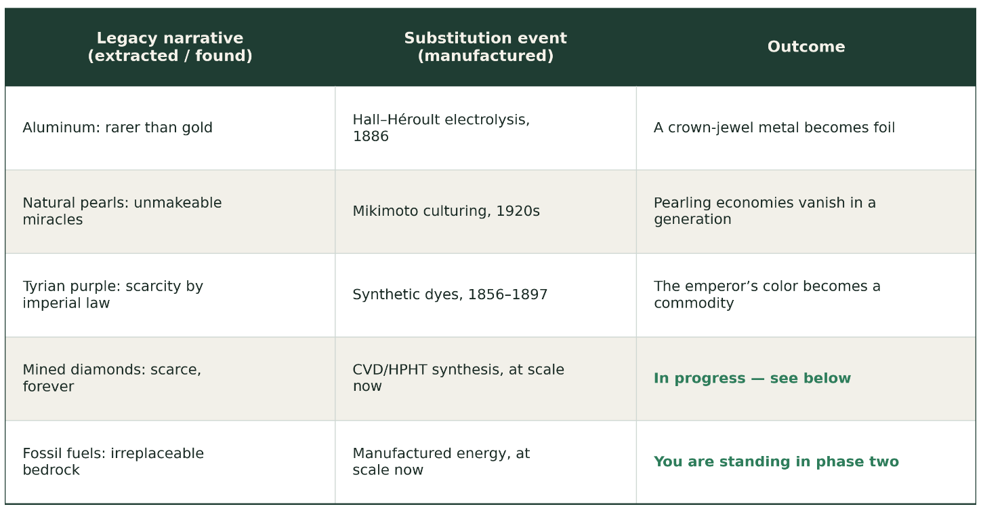
That last row is the point of this essay. The table is not history. It is a live position.
The Cartel That Sued Physics and Then Joined It
Which brings us to the most instructive narrative collapse happening in real time.
For over a century, a cartel sustained the story that diamond value flows from rarity, and when the rarity ran thin, it manufactured the narrative outright. The “diamond engagement ring tradition” was substantially an advertising campaign; “A Diamond Is Forever” was written by a copywriter in 1947. It may be the most successful act of value-narrative construction in commercial history. De Beers didn’t sell stones. It sold a story, and the story priced the stones.
Then manufacturing caught up. Lab-grown diamonds—chemically, optically, and gemologically identical—arrived at scale, and the cartel ran the full incumbent playbook at record speed. It even attempted the boldest move available: in 2018, De Beers launched its own lab-grown brand, Lightbox, priced at a deliberately dismissive $800 a carat, to teach consumers that manufactured stones were fashion, not forever (De Beers, 2018). The lesson took, just not the way it was intended. Consumers learned exactly how cheap perfection had become, and they chose it. By 2025, lab-grown wholesale prices had fallen roughly 90% from Lightbox’s launch benchmark (De Beers, 2025). Manufactured stones had captured more than half of U.S. engagement rings by unit sales (The Wall Street Journal, 2025), and De Beers closed Lightbox to “recommit to natural diamonds” (De Beers, 2025) while its parent, Anglo American, wrote down the value of De Beers by approximately $4.5 billion across 2023 and 2024 and continued pursuing a sale of the business (Anglo American 2024 Results).
The company that invented “A Diamond Is Forever” is discovering the shelf life of forever.
A telling coda: the one part of the synthetic diamond business De Beers kept is the industrial one: manufactured diamond for semiconductors, optics, and quantum applications. Even the incumbent’s own capital, in the end, followed the manufacturing curve.
We are going to spend a full hour inside this collapse with the person who literally wrote the book on how scarcity myths are built and how they die. On July 22nd at 2 PM Eastern, Green Alpha’s Erika Karp and I will be joined by Aja Raden, historian and author of Stoned: Jewelry, Obsession, and How Desire Shapes the World, for a live conversation on the diamond market as a case study in narrative-driven value: how the story was constructed, why it held for a century, and what its unwinding teaches investors about every other scarcity narrative in their portfolios, including the biggest one of all. You can register here.
The Biggest One of All
Every collapse in that table was a product. This one is the input to all products. When we analyze the transition from mined fossil fuels to a factory manufactured-energy economy, we may be watching a related structural mechanic to the one that devalued aluminum and transformed the pearl trade — except the incumbent is not a metal or a gemstone this time. It remains a substantial share of the world’s primary energy, a multi-trillion-dollar annual flow embedded in the price of nearly everything made or moved. Similar mechanics; materially larger stakes.
The consensus narrative holds that fossil fuels are the irreplaceable bedrock of industrial prosperity. That narrative will not collapse because of an ethical awakening or concerns about global warming. Again: nobody stopped whaling out of love for whales. It will collapse for the same reason aluminum, pearls, and diamonds collapsed: manufactured substitutes ride learning curves, and extracted resources ride depletion curves, and those curves only cross in one direction.
The capitulation follows three phases, every time:
1. Defiant denial. The substitute is a toy, unfit for real-world demands.
2. The economic parity cross. Wright’s Law does its work; the substitute reaches cost parity. The incumbent narrative retreats to niche use cases and political subsidy.
3. The capital avalanche. Markets recognize terminal decline. The cost of capital for legacy projects climbs as terminal values evaporate; financing floods toward the scalable, manufacturable alternative; legacy assets strand.
The fossil incumbency has more political leverage, deeper reserves, and greater cultural momentum than any incumbent in history. So did every incumbent in this essay, in its day. The unwind may take decades, and its pace is uncertain. The central question is not only direction, but timing, policy, capital discipline, technological execution, and valuation.
Where the Gap Is Widest
Capturing the value in a narrative collapse requires looking past the macro labels. The crowd sees “climate tech” through an idealistic lens and crowds into the photogenic layer: generation assets, consumer-facing hardware. The unglamorous structural compounders sit at the physical bottlenecks: the things civilization must buy, at scale, regardless of anyone’s politics.
Grid hardware: switchgear and high-voltage equipment. The consensus often assumes the energy transition is primarily a generation story. The physics says generation without transmission is stranded electrons. Systemic electrification, now compounded by data-center and AI load growth, appears to be colliding with tight supply in categories such as high-voltage switchgear and transformers. The market may file some of these manufacturers under boring industrial cyclicals; their order books may suggest stronger demand, though backlogs, margins, and capital returns should be evaluated company by company. They can be viewed as potential toll collectors of the electrified economy, but they remain exposed to industrial cycles, input costs, project delays, and valuation risk. (Recall which technology demolished the aluminum scarcity narrative. Electricity has done this before.)
Structural materials: electric-arc-furnace steel. Consensus may file steel under hard-to-decarbonize legacy industries. But EAF steelmaking never asked for anyone’s climate conscience: mini-mills running recycled scrap on electricity have competed with blast furnaces on plain economics — lower capital cost, flexible operation, domestic scrap instead of seaborne iron ore and coking coal — for decades, and they have captured a substantial share of American steelmaking before “decarbonization” ever appeared in an earnings call. Carbon liabilities and border adjustments may stack one more cost on the incumbent’s side of the ledger; they are an accelerant, not the thesis. Still, the theme carries risks tied to scrap availability and pricing, electricity costs, construction cycles, trade policy, global overcapacity, and demand volatility. The narrative may see a stagnant legacy commodity; the math may see the foundational substrate of adaptation, manufactured in a circular loop.
Risk analytics: spatial data and forward-looking catastrophe modeling. The prevailing narrative treats climate risk as an abstract tail manageable with historical actuarial tables. The tables are under pressure: when “100-year” — even “500-year” — events arrive repeatedly in a short period (Houston famously took three 500-year events in three years), history may become a less reliable pricing guide, and the global reinsurance complex is already repricing accordingly. The firms fusing AI weather modeling, orbital radar, and terrain mapping into asset-level risk pricing may be misfiled as niche software. They could be building part of the pricing mechanism for the next era of capital allocation, while remaining exposed to model risk, data-quality limitations, customer-adoption risk, regulatory scrutiny, competition, and changing insurance-market economics.
For the Long-Term Allocator
Positioning across a narrative collapse demands patience and strict risk discipline. Wrong narratives can dominate for years on inertia alone, and misjudging the velocity of the shift is the classic way to be right and broke. That is precisely why the underwriting must anchor in physical reality – in what civilization structurally requires – rather than in how anyone wishes the world looked. Sentiment is noise. Consensus is a lagging indicator. Machine intelligence may compress some of this. Tools that can mark any narrative to physical reality on demand may strip away part of the analytical excuse for consensus — but they were trained on consensus, and naively used they may amplify it rather than break it. More to the point, the binding constraint was never only the cost of seeing; it is also the career cost of acting on what you see, and no model eliminates that. Expect wrong narratives to persist longer than the data alone would suggest — and to collapse faster once they crack. The gap may survive the machines; the avalanche may get steeper. The math may eventually win, and the work of the long-term allocator is to be positioned where and when it does, without mistaking conviction for certainty.
The cartels didn’t lose an argument. They lost a cost curve. So will the next one.
Important information: This material is provided for informational and educational purposes only and reflects the author’s views as of the date indicated. It is not intended as, and should not be relied upon as, investment, legal, tax, or accounting advice. References to industries, themes, technologies, or market examples are illustrative and do not constitute a recommendation or offer to buy or sell any security or investment product. Investing involves risk, including possible loss of principal. Forecasts, opinions, and forward-looking statements are inherently uncertain and may change without notice. Past performance is not indicative of future results. Readers should consult their advisers and consider their own objectives, constraints, and risk tolerance before making investment decisions.
Green Alpha is a registered trademark of Green Alpha Advisors, LLC. Green Alpha Investments is a registered trade name of Green Alpha Advisors, LLC. Green Alpha also owns the trademarks to “Next Economy,” “Investing in the Next Economy,” “Investing for the Next Economy,” “Next Economy Portfolio Theory,” and “Next Economics.” Green Alpha Advisors, LLC is an investment advisor registered with the U.S. SEC Registration as an investment advisor does not imply any certain level of skill or training. Nothing in this post should be construed to be individual investment, tax, or other personalized financial advice. Please see additional important disclosures here: https://greenalphaadvisors.com/about-us/legal-disclaimers/