
October 2026, Garvin Jabusch, Chief Investment Officer
The Ten-Year Hit Five: Two Trades and a Rate Hike
The third quarter of 2026 rewarded a relatively narrow set of companies while much of the broader market declined. For the quarter, the S&P 500 rose about 2% and the Nasdaq about 2.5%; the Dow fell roughly 2.7% and the small-cap Russell 2000 dropped more than 7%. Only four sectors finished higher. In September, ten of eleven sectors fell, and the exception was technology, supported by semiconductors, which gained more than 9% on the month and was roughly 69% higher for the year, as measured by the VanEck Semiconductor ETF. In our view, investor demand was concentrated in AI-compute and energy-related companies, while many other areas of the market were repriced lower.
Higher interest rates were an important factor during the quarter. On September 16 the Federal Reserve raised the federal funds rate a quarter point to 3.75–4.00%, its first hike since 2023, and the new chair promised a “timelier return” to 2% inflation. The 10-year Treasury yield climbed 88 basis points over the quarter to about 5.3%, its highest since 2002. August CPI printed at 3.4%; crude rose on the order of 30% and Brent finished September back above $100. The arithmetic was brutal for anything that pays a dividend or that looks like a long-duration asset: utilities fell more than 6% in September, real estate more than 7%, and small-cap biotech, the market’s purest pre-revenue, all-terminal-value zone, gave back roughly 8% during the month as the ten-year crossed 5%. And yet, the quarter did not end the AI trade; in our view, it raised the price of admission for everything that has to borrow in order to build.
Our Next Economy® strategies felt both sides of that arithmetic, with final performance figures accompanying this commentary on our portfolio snapshots. We own a great deal of the physical substrate of the AI buildout: semiconductors, grid equipment, power generation, etc., and that helped. We also own rate-sensitive infrastructure, and that did not. So yes, of course, a meaningful share of our recent results has come from the same AI-capex dynamics lifting the broad market, although that has been via a somewhat different set of companies. We think that difference matters a great deal, and most of this commentary is about why.
Hormuz as Weather, Not News
The U.S.–Iran war is in its eighth month, and the third quarter reprised the second: truce, violation, strike, talk, repeat. The 60-day Islamabad memorandum signed in June survived three weeks. On July 7 and 8, after attacks on three commercial vessels, U.S. forces resumed strikes on Iranian coastal sites, Washington revoked its sanctions waiver on Iranian oil, and Brent, which had fallen to about $71 on July 1, climbed back toward $97 by late July. September brought talks over a phased reopening of the strait, a dip in crude, a rejected Iranian proposal, a renewed spike, and a report that the president expects to resume bombing after the midterms. We wrote about this dynamic in April and again in July. It remains real. It is also, by now, getting familiar.
And that familiarity is the point now: Markets are (all too) reflexive, but they are also adaptive, and a threat renewed weekly stops behaving like a threat and starts behaving like something you plan around rather than panic over, like your morning weather report. The real evidence is in the tanker data, not the headlines: Middle East crude exports in September reached their highest level since the war began, and flows through Hormuz recovered to roughly 80% of pre-war volume even as the diplomatic track lurched. Each truce-or-no-truce headline still moves crude for a session; the moves are, in our observation, smaller and shorter than in March. In our view the market will keep discounting the oscillation until a tweet moves oil about as much as a Tuesday does. That’s not complacency, it’s what markets do with a signal that has stopped meaning anything. What continues to carry information is the structural lesson: every month the strait stays contested is another month in which Japan, Korea, India, and Europe accelerate the energy sources that don’t arrive by tanker. And a risk premium that stubbornly refuses to recede is, over any reasonable horizon, a subsidy for electrification. A subsidy which is paid by the oil consumer and collected by the substitute.
The Forcing Function
If the second quarter’s story was the grid as bottleneck, the third quarter’s is the scale of what is pressing against it. The five largest U.S. hyperscalers are now spending roughly $800 billion a year on AI infrastructure, nearly double last year’s pace, and Goldman Sachs strategists project that figure will rise by more than half again next year, to about $1.2 trillion. Their capital expenditures already exceed their operating cash flow, which means the buildout is being financed with debt and equity rather than retained earnings. These are not software numbers with massive margins. They are concrete, copper, transformers, turbines, cooling water, and switchgear, and they are now large enough to show up in the national accounts as the one thing holding up an entire category of economic activity.
Which is clear in Exhibit 1. Since December 2023, the annualized rate of U.S. private construction spending on data centers has risen by about $51 billion. Spending on everything else has fallen by about $120 billion—and turned negative in mid-2025, before the rate shock, before the war. Strip out data centers and the United States has been in a private-construction recession for more than a year. One category of building is carrying the physical economy’s capital formation, and that category exists to feed compute.
Exhibit 1: Data centers are the only private construction still growing
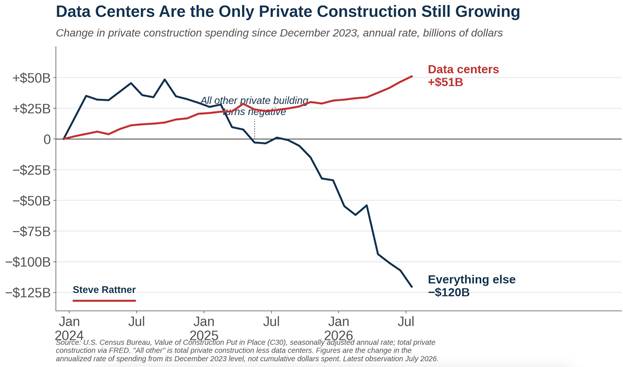
Change in U.S. private construction spending since December 2023, seasonally adjusted annual rate, billions of dollars. Source: U.S. Census Bureau, Value of Construction Put in Place (C30), via FRED; chart by Steve Rattner. “All other” is total private construction less data centers. Latest observation July 2026.
This is what we mean when we call the AI capex surge a physical forcing function. For thirty years the digital economy could tell itself that it was asset-light, but now we can all see the reality. Every AI model requires an inference chip, a memory chip, a server, a rack, a building, a power substation, and a source of electricity generation that can be permitted and connected yesterday. The energy transition no longer needs an advocate; it has a customer with a budget in the hundreds of billions and a deadline. In our opinion, the asset-light legacy technology franchise is the exposure most at risk in this regime, and the asset-heavy physical substrate (clean generation, grid, storage, and the semiconductors that make them efficient) is the exposure most favored by it.
But the chart is a double edged sword. An economy whose private construction rests on one category has a single point of failure. If AI capital spending pauses, and a buildout financed on borrowed money is one that credit markets, not product roadmaps, can pause, the construction recession already present beneath the data-center line will one day be the headline and no longer the footnote. We are not forecasting that pause; we think it is the risk the market is least willing to price. Goldman’s own list of things that could slow the spend (these are power, labor, memory, and construction capacity) is, not coincidentally, a list of things we own. We also think transformers and grid capacity are needed, whether or not the next model ships on schedule. The grid doesn’t care what the load is for.
The Benchmark Became a Momentum Trade
Which brings us to a point we have been making in longer form since August, in The Yardstick That Ate the Market. A capitalization-weighted index is a capital-allocation rule as much as it is a measuring stick, and the rule is simple: hold more of whatever has already gone up. That is not a defect. It is the design, and it is what makes index funds cheap, diversified, and tax-efficient. But it also means that when a handful of companies at the center of one narrative lead the market, the index concentrates in that narrative by construction. In our view, cap-weighting carries an embedded momentum tilt, and in a market this narrow the tilt is doing most of the work. The flows that track an index do not render a valuation judgment; they buy at whatever price the market has set, because that is what the mandate requires. The September divergence between technology and the other ten sectors, and the small-cap drawdown beneath it, are what you would expect to see if that is right. They do not, on their own, prove it.
We have also benefited from that mechanism: flows that lift the index can also lift physical suppliers to the index’s favored companies, and we own many of them. But there is a difference between owning the substrate and owning the story. The index holds model-makers and platforms at substantial weights, while transformer manufacturers, grid-equipment suppliers, power-semiconductor firms, and clean-generation developers may represent much smaller weights or may not be included at all. When the narrative is strong, both groups can rise. When it weakens, however, the index’s concentration may increase its exposure to a reversal in the same narrative. In our view, a flow-driven market can create opportunities for active management that focuses on companies the dominant story depends on but may not fully reflect in their valuations. We refer to this approach as narrative arbitrage. It remains subject to valuation, security-selection, concentration, and market risks, and there is no assurance that the market will recognize the value we perceive. We are not arguing that passive investing is unsuitable for all investors. We are observing that a capitalization-weighted benchmark delegates allocation decisions to market capitalization rather than to an assessment of each company’s prospective risk and return.
Navigating What Comes Next
The question clients are asking this quarter is sensible: if the Fed is hiking into a buildout, does that stop the buildout? Our answer is that a higher cost of capital does not cancel physical demand but it does make demand more selective about who gets paid. Marginal projects get deferred, but indispensable suppliers, those with the equipment, the interconnection, the backlog, and the balance sheet, get the orders that remain. A 5.3% ten-year is painful for a developer financing a merchant plant. It is far less painful for a company that sells the developer the switchgear and books the deposit in advance. We have tried to hold the second kind of business, and Q3 was a useful test of whether we have succeeded in that.
Our companies, in electrification, grid modernization, dematerialization, advanced materials, precision agriculture, water infrastructure, AI-enabling semiconductors, and clean power generation, are not ideological bets on sustainability. They are investments in the firms building the productive infrastructure of the only economy that is not self-terminating. This quarter, the largest companies on Earth signaled they intend to spend more than a trillion dollars next year pulling that infrastructure into existence on an amped-up schedule. We did not plan for that customer. We planned for the physics, the underlying hard reality, if you like, and the customer showed up.
Today’s asset allocation is tomorrow’s production function. Q1 illustrated the principle through crisis, Q2 through recovery, and Q3 through the most obvious mechanism of all: hundreds of billions of dollars being converted, in real time, into the physical economy we have spent years positioning for. In our view, a portfolio anchored to a cap-weighted index leaves investors bearing the valuation risk of the AI narrative while holding comparatively little of the infrastructure and industrial suppliers whose order books that spending is filling. We believe our approach offers an alternative. Not because it is virtuous, but because owning what the economy is being built out of is a sounder basis for durable investment than owning the story about it. We remain constructive. Rates and shipping lanes will remain headwinds right up until they don’t. Our job is to stay positioned for what we believe is the most consequential economic transformation in modern history, and to let the physics, rather than the tape, decide what we own.
Disclosures: This commentary is provided for informational and educational purposes only and does not constitute investment advice, an offer to sell, or a solicitation of an offer to buy any security or investment strategy. References to portfolio positioning, contributors, and detractors are qualitative and must be read together with the accompanying portfolio snapshots and their performance disclosures; they do not present complete performance results and should not be understood as representative of every holding, account, or period. The views expressed are those of the author as of the date of publication, are subject to change without notice, and may not reflect the views of all Green Alpha personnel. Forward-looking statements, including views regarding markets, industries, policy, technology, demand trends, portfolio positioning, or anticipated capital spending, are based on current expectations and assumptions and are inherently uncertain. Actual outcomes may differ materially. References to specific securities, industries, sectors, asset classes, indexes, or strategies are for illustrative purposes only and should not be construed as recommendations or as an indication that any security has been or will be profitable. Holdings and exposures may change without notice. Any securities or themes discussed may perform differently from the examples described, and the commentary does not identify every position, contributor, detractor, or material risk. Indexes are unmanaged, do not reflect fees or expenses, and are not available for direct investment. Past performance is not indicative of future results. Green Alpha Advisors, LLC is a registered investment adviser. Registration does not imply a particular level of skill or training
Green Alpha is a registered trademark of Green Alpha Advisors, LLC. Green Alpha Investments is a registered trade name of Green Alpha Advisors, LLC. Green Alpha also owns the trademarks to “Next Economy,” “Investing in the Next Economy,” “Investing for the Next Economy,” “Next Economy Portfolio Theory,” and “Next Economics.” Green Alpha Advisors, LLC is an investment advisor registered with the U.S. SEC Registration as an investment advisor does not imply any certain level of skill or training. Nothing in this post should be construed to be individual investment, tax, or other personalized financial advice. Please see additional important disclosures here: https://greenalphaadvisors.com/about-us/legal-disclaimers/